ECOLE POLYTECHNIQUE DE LOUVAIN

Comparison between silicon and MAPI
On Fig. 23, we have a comparison of the absorption coefficient for 4 kinds of light absorption materials. In our case, we are only interested in c-Si and CH3NH3P bI3. In the visible light range, MAPI has a better absorption coefficient compared to c-Si. c-Si has an indirect bandgap whilst MAPI and the other materials have a direct bandgap. It is interesting to note that αMAP I is similar to the α of other materials having a direct bandgap. We can conclude that our perovskite is better at absorbing sunlight than crystalline silicon. Hence, perovskite based solar cells will be thinner than traditional ones.

Figure 23: α(λ) of c-Si, a-Si:H(10%H), GaAs and CH3NH3PbI3 materials. Data obtained with spectroscopic ellipsometry. The measurements were made on a thin-film MAPI of 330 nm. [23]
On Fig. 24, we can observe that c-Si has a higher refractive index than MAPI. High refractive indexes are unwanted in the case of photovoltaïc cells because it causes light to be reflected and generates losses. This, in turn, lessens the efficiency of the cell.
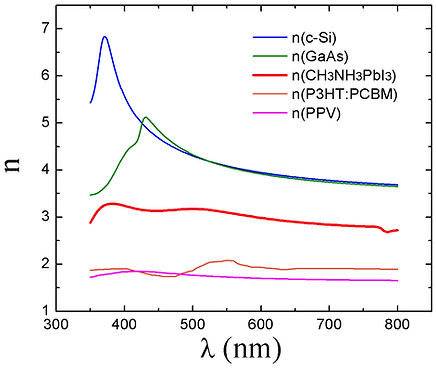
Figure 24: Comparison of n(λ) for c-Si, GaAs, CH3NH3PbI3, P3HT:PCBM and PPV. Data obtained with spectroscopic ellipsometry. The measurements were made on a thin-film MAPI of 330 nm.[23]
Perovskite also has other advantages compared to crystalline silicone. Its manufacturing process is easy, industry-friendly and energy efficient. This is especially important because the energy used during fabrication is a huge contributor to greenhouse gas emissions. This is further expanded on in the Life Cycle Assessment section of this website.